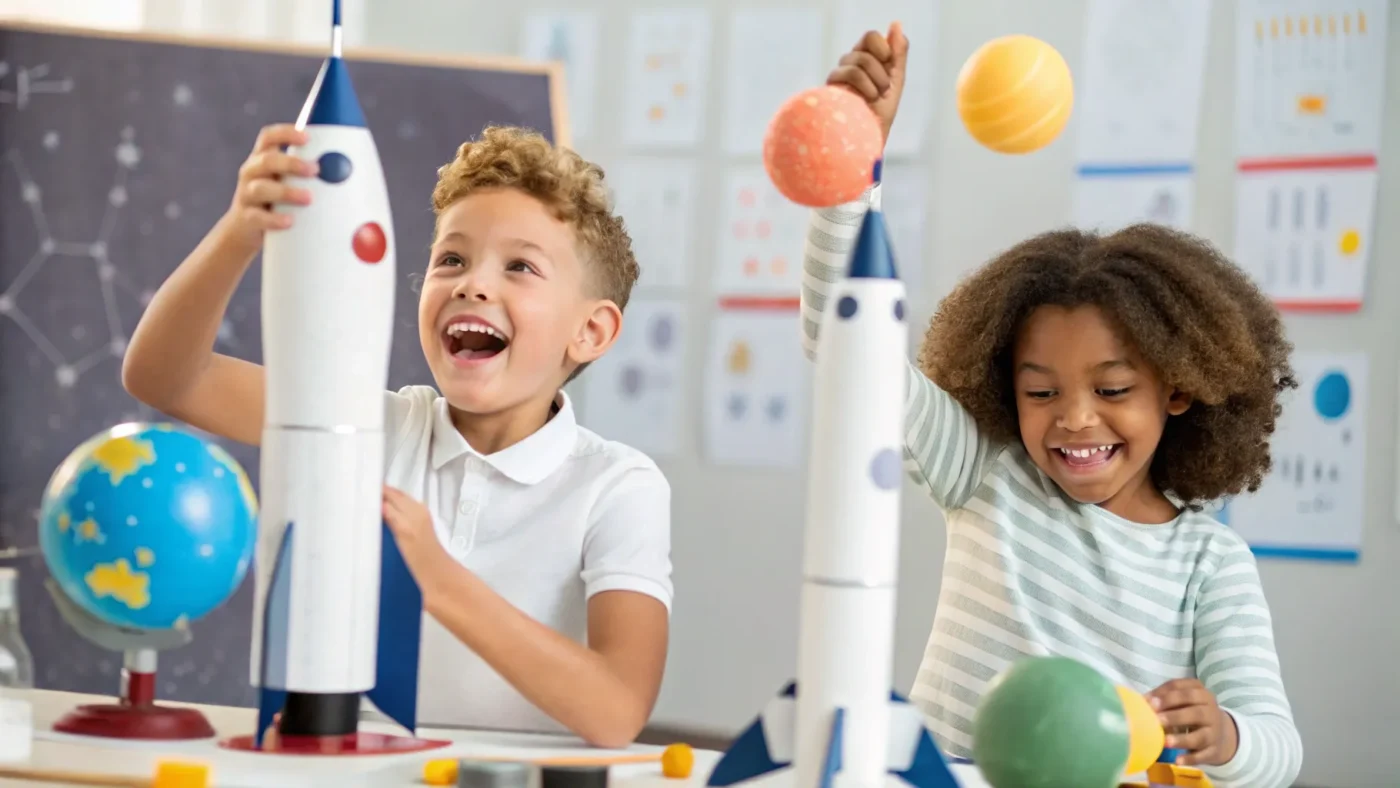

Space captures young imagination very quickly. Bright planets and distant galaxies invite curiosity. Students often dream about rockets and astronauts. So, teachers can use space themes for STEM lessons. A strong narrative makes learning feel like adventure. The classroom then becomes a mission control center. Curiosity grows when students feel part of discovery.
Sometimes traditional lessons feel dry and distant. Abstract formulas seem hard for young minds. Space missions provide a vivid learning context. A mission story gives purpose to each task. Students start solving problems with real excitement. So, attention improves during science and mathematics activities. Digital mission platforms now support this approach well. One example is Mission.IO which designs interactive learning missions. These missions simulate real space exploration challenges.
Story Driven Missions Encourage Curiosity
A story captures attention from the beginning. A spacecraft may face a technical failure. Students receive the urgent signal from mission control. The class must diagnose the problem quickly. Each clue reveals new scientific concepts. Sometimes a mission involves exploring distant planets. Students analyze environmental data and orbital patterns carefully. Scientific reasoning develops through active exploration tasks. Curiosity stays strong throughout the experience. The classroom energy rises during every mission stage.
Mission.IO often designs scenarios with dramatic challenges. Students may stabilize satellites or repair space stations. The storyline supports structured scientific inquiry methods. Knowledge grows through context and experimentation.
Real World Context Strengthens Understanding
Space exploration connects many STEM disciplines together. Physics explains motion and gravitational forces. Mathematics supports navigation and trajectory calculations. Engineering guides spacecraft design and system reliability. Real missions demonstrate practical scientific applications. Learners appreciate why knowledge truly matters.
Mission.IO designs missions that mirror authentic research situations. Students learn to interpret complex mission data carefully. Decision making becomes part of the scientific process. Confidence grows through meaningful problem-solving experiences.
Applying Missions to Classroom Learning
Teachers can integrate missions into regular lessons easily. A mission might explore planetary geology or orbital mechanics. Each challenge introduces a specific scientific concept. The narrative structure keeps learners invested.
Educators also value missions for structured skill practice. Some lessons include problem solving activities for 6th grade students within the mission narrative. These tasks develop reasoning and analytical thinking. Students apply mathematics and science knowledge naturally. Sometimes reflection follows the mission experience. Students review decisions and discuss alternative strategies. This step strengthens conceptual understanding. Knowledge becomes easier to retain and apply later.
Conclusion
Space themed missions transform ordinary STEM lessons. Stories create purpose for scientific exploration. Students feel like active participants in discovery. Engagement grows through challenge and collaboration. But deeper benefits appear beyond excitement alone. Analytical thinking develops through structured mission tasks. Real world context strengthens conceptual understanding steadily. Learners connect knowledge across many scientific fields. STEM learning becomes memorable and meaningful for every student.